Handbag Virtual Try-On: Why Bags Are the Accessory AI Solves and AR Never Did
“Virtual try-on” conjures a face full of sunglasses or a live camera overlay. Handbags sit oddly in that picture — and that's the tell. Bags are the accessory AR spent a decade not solving, and the one 2D AI turns out to fit best.
The short version: the accessory nobody cracked in AR is the one 2D AI fits best. A bag's buying question isn't “does it sit right on my face?” — it's “how big does this read against my body?” That's a proportion judgment a still image answers completely, which is exactly why AR's expensive spatial machinery (a 3D model per bag, a live camera) never made sense for handbags and stayed pinned to luxury flagships. 2D AI draws the bag at its listed dimensions onto the shopper's own photo — so scale, the whole decision, is what it shows — for about $0.067 a render, on the page for every visitor.
What is a shopper actually deciding when they look at a handbag?
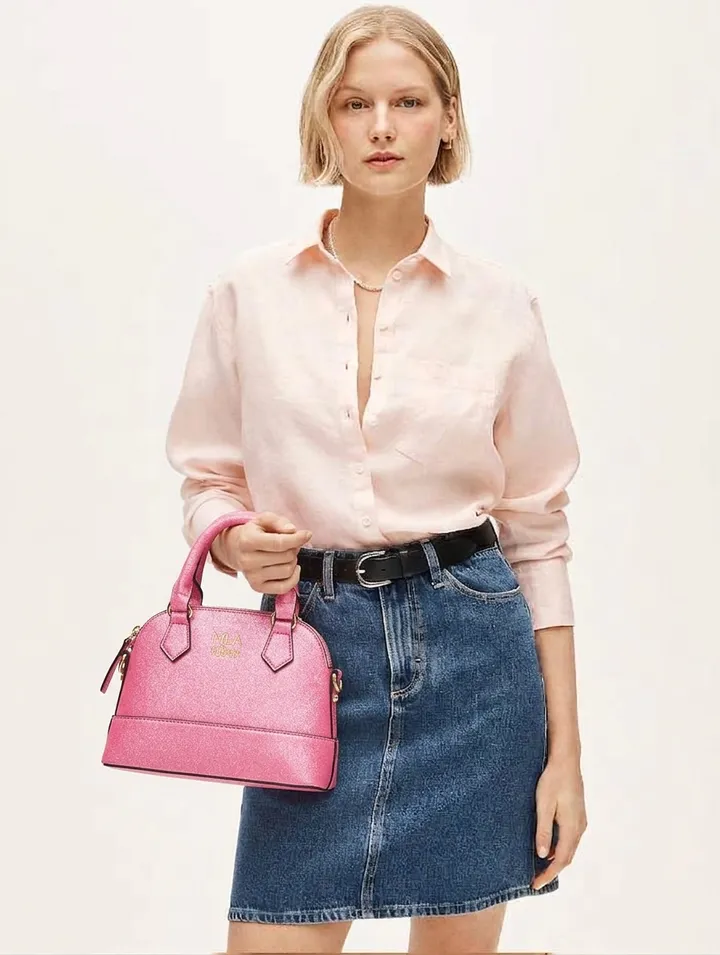
Not whether it fits. A bag has no size chart in the apparel sense — it clasps, it hangs, it holds what it holds. The real hesitation is scale and proportion: is this a dainty top-handle or a slouchy weekender, and how big will it read against my frame? Product photos hide exactly that — a bag shot on a white background, or on a 5'11" model, tells you nothing about how it sits on you. There's no universal handbag sizing standard, so shoppers are told to “check the dimensions”: width × height × depth in centimetres they can't picture. The decision is visual and comparative — this object, at this size, against this body.
Why did AR never crack handbag try-on at scale?
Because a bag has nowhere to anchor. AR works by registering a 3D object to real-world geometry it can track — a face for glasses, a wrist for a watch, a floor for furniture. A handbag is carried: held in a hand, hung on a shoulder, swung crossbody, set down. There's no fixed landmark to lock onto, so the only way around it is to hand-build a 3D model of each bag — expensive, and per-SKU. That cost pinned AR bag try-on to luxury flagships: Ralph Lauren put its Wellington bags into Snapchat lenses, and Gucci and Dior run 3D-model try-ons through AR partners. For everyone else the math never closed: a 3D asset per bag lands in the same band as apparel 3D (~$99–$349 per SKU), and then only the shoppers who grant a camera ever see it.
Why is 2D AI a natural fit for bags specifically?
Because it answers the scale question directly. A generative model paints the bag onto the shopper's own photo from your existing flat product image — no 3D model, no camera — and it can draw the bag at the dimensions the listing states, so a small camera bag and a large tote come out looking like genuinely different bags on the same person. That's the part AR's machinery was overkill for: the shopper never needed millimetre-accurate spatial registration, they needed to see the proportion. A still image is enough — and it sits on the product page for every visitor, not behind a camera prompt for the few.
| AR bag try-on | 2D AI bag try-on | |
|---|---|---|
| What it needs | A hand-built 3D model per bag + the shopper's live camera | One flat product photo you already have |
| Cost to add | $99–$349+ per SKU in 3D assets, redone as the range turns over | ~$0.067 per try-on — no asset prep (our data) |
| Who sees it | Only the ~15% who grant the camera and tap in | Every visitor — it renders on the page |
| Answers | Where the bag sits in 3D space (which bags don't need) | How big the bag reads against the shopper's body |
| In the wild | Luxury flagships (Ralph Lauren, Gucci, Dior) | Any store with product photos |
AR bag try-on spent a fortune answering a question shoppers never asked — where does this sit in space — while the question they do ask, how big does it read on me, is exactly what a generated still resolves.
Does seeing a bag on yourself actually change the buy?
The confidence evidence is consistent, and none of it depends on measured fit: 59% say a try-on helps them picture an item on themselves (Nosto); a 505,416-shopper meta-analysis found try-on lifts purchase intent (Vieira et al., 2022); AR try-on users were 80% more confident and 67% less likely to return (Snap + Publicis, N=4,028). And the downside risk is lower for bags than for clothes — size/fit drives most apparel returns (the #1 cited reason, ~50–70%, Coresight/EEA), but accessories return far less, commonly ~10–15% versus ~20–26% for apparel, because they don't hinge on sizing. A bag try-on is almost pure upside.
The reach math, on one product line
A bag line with 8,000 monthly visitors: a 2D AI try-on renders on the page for all 8,000 at ~$0.067 each (~$536, our data), no camera. An AR equivalent — if you even built the 3D models — only runs for the ~15% who grant a camera, about 1,200 of 8,000 (the midpoint of measured AR/3D engagement, ~8–23%, The Interline). Same traffic; one architecture reaches several times more of it, and the AR bill is the per-bag 3D model.
- 2D AI — renders on the page for every visitor: 8,000
- AR — only the ~15% who grant a camera: ~1,200
Where is AI bag try-on honestly weaker?
It's a depiction, not a measurement. It shows how a bag reads on the shopper; it won't tell you exact interior capacity or how the leather breaks in over time. Very hardware-heavy or transforming bags (convertible straps, structured flaps) can render imperfectly, and a messy input photo makes a messier result. None of that touches the scale decision shoppers actually stall on — but it's worth saying plainly rather than pretending a generated image is a spec sheet.
What this means for your store
If you sell bags, you're sitting on the accessory that 2D AI fits better than anything AR could offer — and that most competitors still show on a plain white background. The job is scale confidence, and a still image on the shopper's own photo does it. That's the lane Ello is built for: 2D AI on the shopper's existing photo, no 3D models and no camera, drawing each bag at its listed dimensions with crossbody and handheld views from one render, at ~$0.067 a try-on (our data). See how it compares to the other Shopify try-on apps, including the accessory-capable ANTLA, look at the dedicated bags page, or check real client results.
FAQ
Can you do a virtual try-on for handbags?
Yes. A 2D AI try-on renders the bag onto the shopper's own photo from your existing flat product image — no 3D model and no camera. It can draw the bag at its listed dimensions, so shoppers see how the size reads against their body, which is the main thing they hesitate on with bags.
Why isn't there more AR handbag try-on?
A bag has no fixed anchor point on the body the way glasses have a face or a watch has a wrist — it's carried and positioned freely — so AR has nothing to track without a hand-built 3D model of each bag. That per-SKU cost kept AR bag try-on inside luxury flagships like Ralph Lauren, Gucci and Dior.
What's the best way to show handbag size online?
Beyond listing width × height × depth, show the bag on a body at true scale. A 2D AI try-on drawn at the listed dimensions lets a shopper see a small camera bag and a large tote as different bags on the same person — far more intuitive than centimetres they can't picture.
Is AI handbag try-on accurate?
For scale, proportion, colour and how the bag reads on the shopper — which is what the purchase turns on — it's very good. Its limit is that it depicts rather than measures: it won't give exact interior capacity or how the leather ages, and very hardware-heavy or transforming bags can render imperfectly.
Sources
- Snap + Publicis (2022, N=4,028) [A] — try-on users 80% more confident, 67% less likely to return.
- Vieira et al., J. of Business Research (2022) [A] — 505,416-shopper meta-analysis, purchase intent.
- Nosto / Censuswide (2022) [A] — 59% say a try-on helps them picture the item.
- European Environment Agency (2024) [A] — ~20% of online clothing returned; ~70% from poor fit or style.
- Richpanel — Return Rates by Category (2026) [C] — accessories return ~10–15% vs ~20–26% for apparel.
- Coresight Research (2023) [B] — size/fit is the #1 cited apparel return reason (~53%).
- Google — Virtual try-on for dresses (Sept 2024) [A] — AI try-on images get 60% more high-quality views.
- Inverse — Dior, Fendi & Ralph Lauren on Snapchat (2022) [B] — luxury AR bag try-on (Ralph Lauren Wellington), 3D-model-based.
- Marketing Dive — Gucci Snapchat try-on [B] — luxury AR try-on at flagship scale.
- Cad Crowd — 3D Rendering Cost (2026) [C] — per-SKU 3D asset $99–$349.
- The Interline (Mar 2026) [B] — AR/3D engagement ~8–23%; scanning costs hundreds per item.